
In many classrooms across New Jersey, educators are welcoming Multilingual Learners (MLs) with diverse educational backgrounds. This can bring two simultaneous challenges for educators: English language acquisition and building foundational content knowledge.
As a districtwide ESL Coach (Jenna Maneri) and a third-grade teacher (Kimberly Cook), we began working together to support one particular newcomer ML in the math classroom who needed to build foundational math skills in order to access the third-grade math standards. While targeting one specific student, we managed to create an engaging activity that enhanced learning for all students.
Jenna: Getting started
As the Bridgewater-Raritan District ESL Coach, I partner with educators of MLs across all grade and content areas. Frequently, newcomer MLs arrive with different educational backgrounds and often have interrupted formal education. In addition to language instruction, MLs often require content instruction that does not align with their grade level placement.
I have worked with general education teachers who have received newcomer MLs that are struggling with math. The students are in upper-elementary, middle or high school grades where it is increasingly difficult for them to access grade level math when they have not yet mastered foundational skills. Add in the lack of English proficiency, and this presents an even bigger challenge for both student and teacher.
This leaves us to confront the following questions:
- How are we bridging learning gaps?
- How do we teach language and content simultaneously?
- How does this targeted instruction benefit and connect to all learners in the classroom?
Part of my role as an ESL Coach is to use my expertise to see how I can help and collaborate with teachers of MLs. There is no magic wand but sometimes having a thought partner to bounce ideas off, model a new strategy or co-teach with makes everyone feel more at ease. Together with classroom teachers, along with other stakeholders such as interventionists, specialists and administrators, we have conversations to see what makes the most sense and is the best for students based on what is within our control. This ranges from assessing in their home language, utilizing Multi-tiered Systems of Support (MTSS), inviting them to our extended-day programs, offering extra ESL time during the day and other scheduling accommodations.
Kim: Collaboration and co-planning
In six years of teaching, I have taught many populations of students with diverse needs. With each set of students, I have also experienced varying levels of collaboration. This has ranged from working daily with co-teachers to checking in with different coaches as needed. Consequently, I have become comfortable contacting other departments. My first experience with co-planning came with a dedicated ESL co-teacher at my first school through a writing exercise. It was my first taste of what was possible when putting multiple heads and experts together, and to this day I am immensely grateful for any opportunity to plan and execute lessons with others.
The school year started like any other. After getting to know our students, the ESL teacher and I developed plans to best meet their needs during our English Language Arts blocks. This ebbed and flowed as we experimented with different options, though we settled in by mid-October. Soon after, I received a new ML in my class. As I collected various sources of information, I discovered that I would need more hands on deck. Based on past experiences, I knew I would especially need additional support during my math block.
Jaime arrives
Our collaboration began with a focus on supporting one particular ML named “Jaime.” Like other MLs across the district, Jaime was struggling to access math standards because he needed foundational math intervention first.
We began by teaching him key words that he could attach to specific operations. To achieve this, we created scaffolded vocabulary cards that were color-coded by operation. Jaime loved picking a card and attaching it to the correct operation. It became a game for him.
We practiced saying and repeating the words, then saying simple phrases, like “how many means addition.” Once he was confident with the new vocabulary, we replaced the scaffolded color-coded cards with non-colored cards. Then, we assessed his knowledge by applying it to addition and subtraction word problems.
Keys to the classroom for second language learners
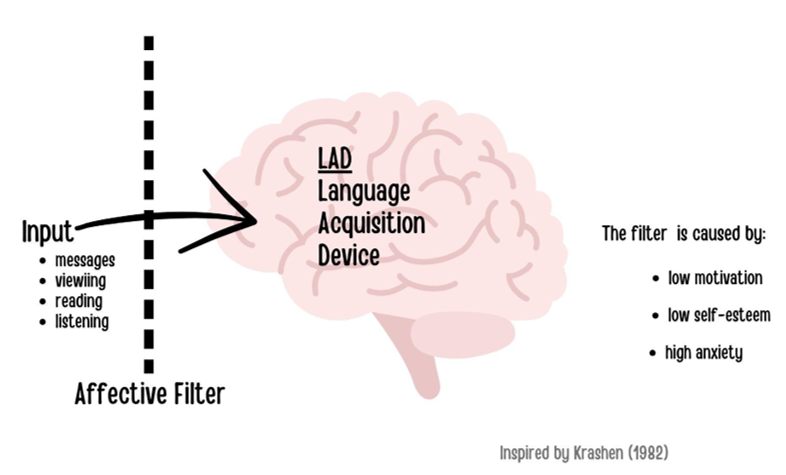
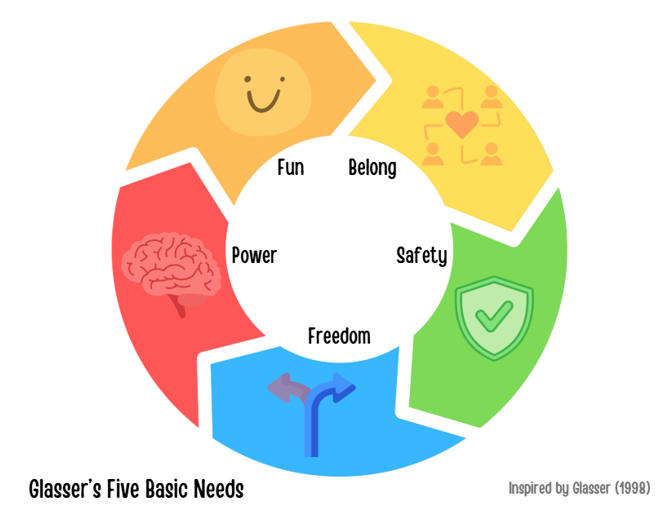
While keeping Jaime’s social-emotional, content and language needs in mind, we were reminded of William Glasser’s Five Basic Needs and Stephen Krashen’s Affective Filter Hypothesis.
Glasser identified five basic human needs as a part of his Choice Theory. He was of the belief that, assuming classrooms already offer a sense of safety and (educational) power, students need to experience freedom, fun and belonging throughout the day, as these elements dictate behavior.
Meanwhile, the affective filter is an imaginary wall that prevents language input or messages from being received by the ML. The key factors that contribute to putting up the imaginary wall or filter are motivation, self-esteem and anxiety.
By combining Glasser’s and Krashen’s findings, we were able to establish a welcoming environment where all students felt comfortable and open to learning through carefully crafted lessons. This was especially important for Jaime, as he did not start the year with the class in September and needed to develop relationships with everyone in the classroom.
Freedom and fun
Through this work, we noticed that the strategies we were using to support Jaime would be beneficial for the entire class as they worked on word problems with all four math operations (NJSLS 3.OA.D.8.). With that and Glasser’s basic need of fun in mind, we decided to put together an escape room.
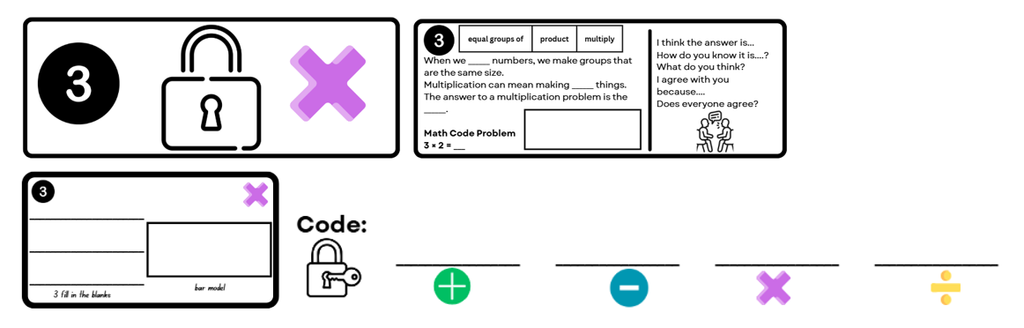
The escape room clue cards focused on two things: using a cloze reading clue for each of the four math operations to practice language—inspired by Jaime’s vocabulary sort—and using bar models to solve each problem. Each solution led the students to a passcode to “escape” the classroom. Before the activity, we thoughtfully determined student teams and modeled how to do the tasks and interact with peers. We noticed that students were up, moving, engaged, participating, sharing, learning, negotiating meaning and having fun! Notably, we were encouraged by Jaime’s willingness to speak up during the vocabulary section of each clue.
Opening the door for other opportunities
Math is heavy in academic language, but this vocabulary is crucial for all learners for all subjects! While intentionally teaching this language through an engaging, scaffolded activity, we were able to strengthen comprehension, communication, confidence and interaction among students. In the future, now that we’ve unlocked the door, we hope to continue this collaborative relationship to create learning opportunities that align to Glasser and Krashen’s findings and allow MLs of all levels to participate. These include repurposing the escape room for other subjects, the creation of choice boards (freedom), and other game-based activities (fun).
MLs are ready and able to access mathematical content, despite learning gaps. They merely need the right systems set in place. The key is in your hands. Will you unlock the door for your students?