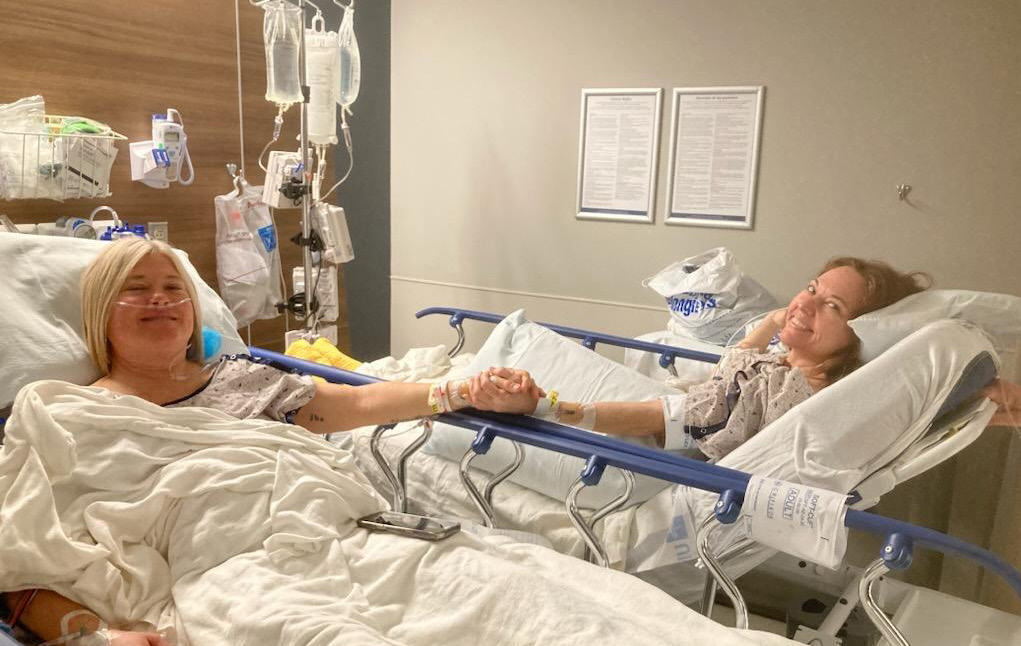
By all accounts, Cranbury is a tight-knit community. But for health and physical education teacher Cathy Elliott, nothing could have prepared her for the generosity and support she received on her organ donation journey.
A Type 1 diabetic since childhood, Elliott made health and fitness a priority. She’s been a teacher for 28 years, 21 of them in Cranbury, and has served as the local president for 17 years.
“Knowing I’m a diabetic, I’ve tried to keep everything else healthy in my life,” Elliott says. “But two years ago, my kidney doctor asked me if I had a donor. At the time, I didn’t know that I would need a donor. But my numbers were trending down, and I was considered in kidney failure, even though I felt completely healthy.”
By June 2025, Elliott began to feel the impact of her diagnosis. She reached out to Erica Kaufman, an English teacher and her closest classroom neighbor, and told her she needed help. Kaufman worked with Andrea Kaplan, a special education teacher, and they promptly created a website to help locate a donor and shared the QR code everywhere.
More than colleagues
Lisa Csatari is a fourth-grade teacher in Cranbury. She’s known Elliott for 21 years and was well aware of her health challenges.
“I knew that Cathy’s health was getting worse, but in late August, one of our colleagues posted on Facebook that she needed a donor. I was on a cruise with my mom when I saw it, and I automatically clicked the link,” Csatari recalls.
A social worker followed up to confirm Csatari was willing to proceed with the vetting process. She went in for blood samples and urinalysis.
“They meet you with a big binder and walk you through the social-emotional component,” Csatari says. “They want to make sure you’re making an informed decision and that you have family or friends who can help care for you.”
There were additional tests to ensure that Csatari was healthy and to confirm that she and Elliott were a match. Csatari has never met anyone who was an organ donor before, but the staff at Robert Wood Johnson University Hospital in New Brunswick answered all her questions. For Csatari, the decision was clear.
“We work in a town with only one school, and everyone knows each other. Pre-K through eighth grade are all in the same building,” Csatari says. “The school district has been really cooperative and supportive. It’s laparoscopic surgery and I have plenty of sick time. I’m not married, no kids, so my availability was easy. The biggest challenge was Cathy’s ability to handle the surgery. Your body has to be in good health to go through the surgery, but ironically, you’re not in good health.”
A lifesaving match
In October, once Csatari was confirmed as a match, she texted Elliott.
“I was at school, and I got the text,” Elliott says. “I looked up and Lisa was standing right in front of me.”
Elliott had gone back to school in September but by November she was hospitalized. The issues with Elliott’s kidneys revealed cardiac issues, as well.
“It was a lifesaving thing that my kidneys failed. I had no signs of heart issues. If it had gone undetected, I would have had a heart attack or a stroke,” Elliott says.
The goal was to avoid dialysis, but by the new year, Elliott was juggling work and dialysis three times a week for four hours while preparing for a kidney transplant on March 24.
A very different spring break
Ever the committed teachers, Elliott and Csatari were happy the surgeries were scheduled before spring break so they would miss less time with students.
The recovery for Elliott is expected to be six to eight weeks. For Csatari, it could be two to six weeks. Elliott is looking forward to her life post-surgery.
“The doctors said I’m going to feel so great,” Elliott says. “They said I would feel like a million dollars, but you have to be careful because you’re going to be immunocompromised. They’re afraid that I’m going to get sick. Unfortunately, I love going to the gym and I work in a school, so all the places I enjoy are known germ havens.”
Csatari is grateful for colleague Heather Odman who volunteered to teach Csatari’s classes while she was recovering.
“Transplant is near and dear to Heather’s heart,” Csatari says. “One of her twin sons is the recipient of an organ donation. She wanted to pay it forward as a thank you to the organ donor. She also knew I would recover more easily knowing she was with my students.”
Cranbury’s school family
Elliott has 13-year-old twins, a son and a daughter, who also attend school in Cranbury. Everyone in the community is aware of the surgeries and is eager to help support Elliott and Csatari.
“This is a lovely community in general,” Csatari says. “We’ve had students in the past who were ill. Different families have experienced loss and hardship. So many people say Cathy is the heart of the school. She is so involved in the district. She’s on every single committee. She’s been an association representative for 17 years. She coaches sports. She’s the athletic coordinator. She’s with every classroom and every grade. Everyone wanted to jump in to help her.”
In fact, three other people went through the whole testing process to find out if they were a match with Elliott.
For Elliott, the response from her school community and the town has been overwhelming.
“My school family is truly family to me. When I found out that I had to go to dialysis, they sent me a schedule for a month of who was going to drop me off and pick me up. Retired teachers, teachers still in the district and teachers who have left the district all rallied to help me. I tell them that I do not know what I would have done without them,” Elliott says. For example, Kaufman has been by Elliott’s side for every appointment.
“You wouldn’t believe the things that people have done for me,” Elliott says.
Elliott is also grateful for the support she received from the administration.
“Dr. Jennifer Diszler and Dr. Jennifer Casazza made many accommodations to enable me to work full time while going to dialysis three days a week. I could not have done this without them,” Elliott says.
Elliott praised Csatari for her generosity and humility and is glad to see Csatari receive so much support and encouragement. But as Csatari says, “teaching is about being a role model. It’s not just about the academics.”
Recovering and moving forward
Elliott and Csatari are both doing well post-surgery. Csatari was released from the hospital two days after surgery. Elliott was released after six days. While recovery will be a slow process for Elliott, she said she is getting stronger every day and looks forward to returning to her school family. Her amazing strength has inspired countless students, staff and community members.
School employees qualify for leave of absence for organ or bone marrow donation
Under New Jersey law, public school employees are entitled to paid leave if they donate an organ or bone marrow, without losing benefits or job protections. While Csatari did not avail herself of this provision, if you are considering becoming an organ or bone marrow donor, speak to your association president and NJEA field representative.