
One in five students will struggle to read. Many students with reading challenges spend their elementary years flying under the radar, only drawing attention in upper elementary or middle school, by which time every school subject is a struggle. If they qualify for an IEP, they receive accommodations and modifications, but rarely the intensive reading remediation they need. Sending young adults into the world who read below their literacy potential limits their access to higher education and employment. For many, it leaves them with lifelong feelings of inadequacy.
I found myself face-to-face with this unfortunate reality when I realized that my seventh- and eighth-grade ELA students were hitting a plateau around the third grade reading level. Despite my best attempts to remediate gaps, their needs were too varied, and more and more students—often with behavioral issues after many years of struggling—were being funneled into my small special education classroom. I realized I needed to be part of a working system, not a one-woman show.
When my research brought me to a Multi-Tiered System of Supports (MTSS) as an alternative framework, I was skeptical. If your MTSS experience, like mine, has been an endless loop of forms, spreadsheets, meetings and few results, you’ll understand my skepticism that MTSS could be implemented effectively.
Todd Glover, research professor at Rutgers University’s Graduate School of Applied and Professional Psychology, understands. He leads a team that supports districts in MTSS implementation, and he agreed that although many districts say they are using MTSS, only those implementing components aligned with best practices are likely to successfully achieve positive student outcomes.
When MTSS implementation is aligned with research, however, it can be revolutionary.
“I see MTSS as an opportunity to provide access for all students to high quality instruction,” he said, “because we’re using data to identify areas where students may have unmet needs and then proactively addressing those needs.”
Natalie Franzi Dougherty, director of Learning Equity and Academic Recovery at the New Jersey Department of Education (NJDOE), assured me that there are districts in New Jersey utilizing MTSS in ways that align with the research. It’s not a quick fix, however. “This is a multi-year investment to run a true MTSS model,” she said, but “we are seeing districts attack systems in ways that are resulting in real changes.”
But what does that look like, exactly?
I had the pleasure of exploring this question with NJEA members in the Dunellen and Haddonfield school districts.
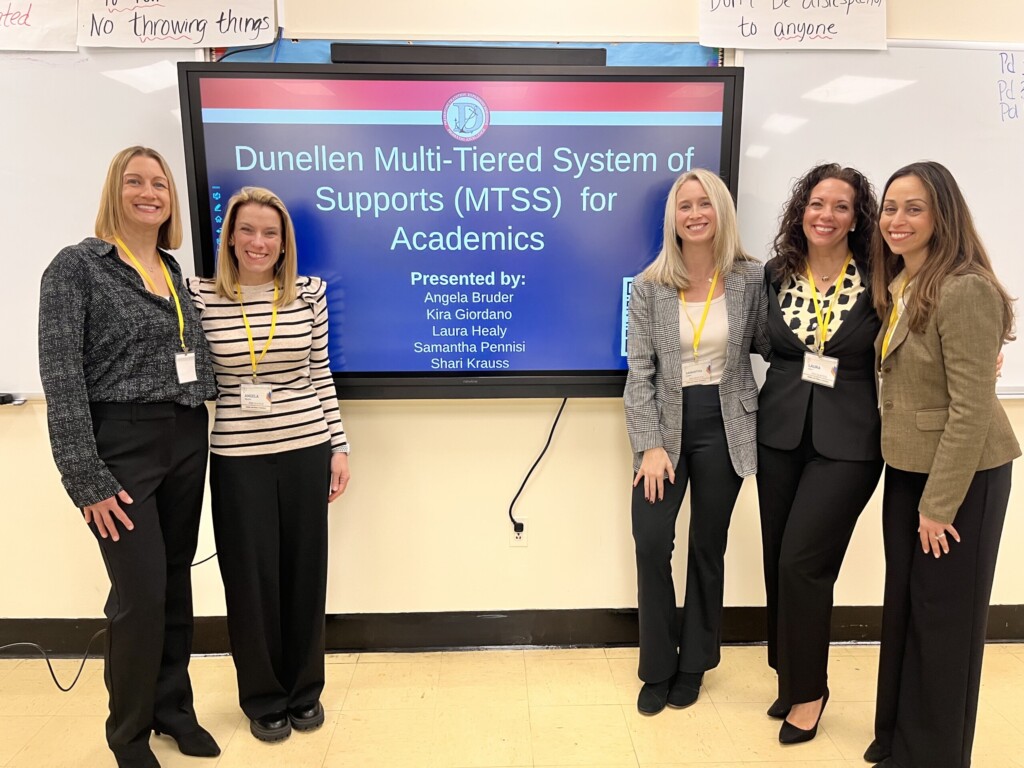
Dunellen: An inclusive push-in model
Here’s an MTSS primer: every student in the school starts on Tier 1, where teachers use evidence-backed instruction in ELA and math. Students are frequently screened for progress, and those who need extra help enter Tier 2, where they receive small group instruction in addition to Tier 1 instruction. Students who need more support enter Tier 3, which is intensive, individualized support.
In both Dunellen and Haddonfield, this process is spearheaded by a team of interventionists, or teachers who specialize in finding and helping the students in Tier 1 who will benefit from Tier 2 and 3 instruction.
I spoke to two interventionists, Samantha Pennisi and Shari Krauss, from John P. Faber Elementary School in Dunellen.
“We start at the beginning of the year with our universal screeners,” said Pennisi. Pennisi and Krauss use this information along with classroom teacher data to build lists of students who they know will need extra time and attention.
“What makes MTSS a gamechanger is that it helps prevent those outcomes, not just respond to them.”
These students enter Tier 2 of what they call their Dunellen Tiered System of Supports. Dunellen’s Tier 2 program is a push-in model, which means that during a 40-minute intervention block built into math and ELA, both the interventionist and general education teacher work with small groups while other students receive enrichment activities. These small groups are where interventionists deliver the extra instruction struggling students need.
After six to eight weeks of Tier 2 instruction, Krauss and Pennisi analyze the data again. If the student isn’t making progress in Tier 2, they enter Tier 3, where they receive more targeted and individualized attention.
Tier 3 still takes place in this intervention block, but the instruction is more targeted and individualized. “We do go a grade or two back [in skills],” Pennisi explained. “Tier 3 students might be missing skills from a previous grade, so Tier 3 might look like eight- to ten-minute small group instruction with just one or two students.”
In Tier 3, the Child Study Team and, if necessary, English as a New Language (ENL) teachers are invited to the process. They meet with the teachers and interventionists and observe the students. About a quarter of Dunellen’s students are English Language Learners, so both Krauss and Pennisi said having insight from the ENL teachers has been a gamechanger.
Dunellen’s push-in model allows students to receive support alongside their peers in flexible groups. Pennisi likes the flexibility and the fluidity of groups. “Students know they may have to work in a group for now, but they know they’re not stuck there.”
This is Dunellen’s third year of implementation, and they’re working on expanding tiers to grades 6-12. Director of Curriculum and Instruction, Meagan Drapkin, saw this system work successfully in her former districts. “Year one is tough,” she said, but she encouraged districts to persevere through the “difficult conversations.”
At Dunellen, they’ve been rewarded for their perseverance. The school’s Median Student Growth Percentile (mSGP) in ELA jumped from 56% in the 2022-23 school year to 66.5% in the 2023-24 school year, well exceeding the state average of 50%.
Notably, the group with the highest mSGP in ELA in 2023-2024 (71%) were students on Level 2, the struggling readers.

Haddonfield: Highly targeted Tier 2 and Tier 3
Kate Linnehan, a Language Arts Specialist, and Megan Saline, a Math Specialist, gave me a closer look at their Tier 2 and 3 interventions at Central Elementary School in Haddonfield.
For them, the heart of the program is their triannual “Data Day,” held before each cycle of intervention. In the weeks leading up to a Data Day, Linnehan and Saline review their school’s universal screeners and administer more specified diagnostic assessments. The day itself is a collaborative session where teachers, interventionists and the principal meet to discuss which students will benefit from intervention. By the end of the day, Linnehan and Saline have student rosters for the cycle’s intervention, along with which skills will be targeted.
“Tier 2, in order to be successful, needs to be highly targeted,” Saline told me. “You have to really look at the data. There is a targeted gap from the previous grade level that’s affecting that student’s access to the grade level curriculum.”
In Haddonfield, intervention takes place during a designated 30-minute intervention period during which students are pulled out in groups to practice skills. Both Linnehan and Saline expressed their preference for this model. In Linnehan’s opinion, having cyclical pull-out groups allows the instruction to remain focused on specific skills and avoids the pitfall of intervention becoming a general “extra help” group.
In math, Saline says she works on fact fluency with students, connecting visuals to equations. Her intervention period features consistent practice and game play to make the facts and patterns stick.
In ELA intervention, Linnehan says she often works on letter sounds and blending in kindergarten, automaticity and sight words in first grade and fluency and accuracy in uncontrolled text in second and third grade.
“By the time I have a fourth or fifth grader,” she said, “because of the systems and interventions in place, most of those kids have cycled out and are not receiving interventions.”
Saline agreed, noting the particular importance of first grade. “If I can remediate them in first grade, I won’t see them again in future grades. If I get a kid in fourth grade, the gaps are too big to make up.”
As in any well-designed MTSS, progress monitoring is essential. “During the intervention cycle, we’re progress monitoring constantly,” said Linnehan. “I want to see if [the intervention] is working.” If it’s not, she may change her approach or document it for the next cycle’s Data Day.
They bring that progress—or lack of progress—to the next cycle’s Data Day, where it will help them make decisions about which kids will leave, stay or move onto Tier 3.
Saline and Linnehan also work with students in Tier 3. They described it as “more time with fewer students.”
“Tier 2 is targeted based on important gaps that need to be filled, like fluency and place value,” said Saline. “When you get to Tier 3, you’re even more targeted based on that student.”
Like Dunellen, Haddonfield’s MTSS is relatively new. Both Linnehan and Saline arrived in the district in 2021, when the system was just “getting its legs.” Data Days were implemented last year, Linnehan said, “to include more voices in the process.”
“Our team has worked hard to grow data literacy in our building,” said Linnehan. “The teachers we work with are amazing. We’re filling gaps earlier and seeing more students exit intervention and continue on their growth trajectories than we were before because everyone is working together towards the same goal.”
And, just like in Dunellen, students have benefitted from Haddonfield staff’s perseverance. While many districts have not recovered from the COVID-related decline, data from the Educational Opportunity Project at Stanford shows that Haddonfield has gained 1.2 grade levels in reading and .4 grade levels in math over the last decade, with the steepest increase since 2021 when the district began implementing their targeted, cyclical MTSS approach.

Your district: Next in line
If you’re wondering why MTSS is suddenly on every administrator’s agenda, Dougherty told me that it’s the convergence of ten years of work at the NJ Department of Education and recent state literacy legislation. “MTSS is the structure that connects literacy instruction, universal screening and intervention into one coherent system,” she told me, “and the state is being very intentional about supporting schools in making that system work well.”
If you’re skeptical about the possibility of MTSS working in your district, Meagan Drapkin, the director of Curriculum and Instruction at Dunellen, suggests visiting districts currently using MTSS.
“Go to places that do the work,” she said. Soon after she was hired in Dunellen, Drapkin brought a group of future interventionists to her former district, Keyport, to see their MTSS in action.
Finally, Glover explained that districts of all sizes and socioeconomic backgrounds can make MTSS work. “It’s about being strategic in our use of resources. We work with districts that, even with limited resources, are able to effectively implement MTSS.” Just as Dunellen and Haddonfield use different approaches, all committed districts willing to think outside the box can make MTSS work for the students who need it the most.
It’s not just about reading. “There’s evidence that continued difficulty with reading leads to an elevated risk of poor overall academic performance, school dropout and mental health concerns for students, like anxiety and depression.” Glover said. “There are lifelong consequences when a student doesn’t acquire early reading skills.”
Dougherty agrees. “What makes MTSS a gamechanger is that it helps prevent those outcomes, not just respond to them. By strengthening Tier 1 instruction and using data to provide timely support, MTSS helps more students experience success early. That builds confidence and sets a stronger foundation not just for school, but for life.”