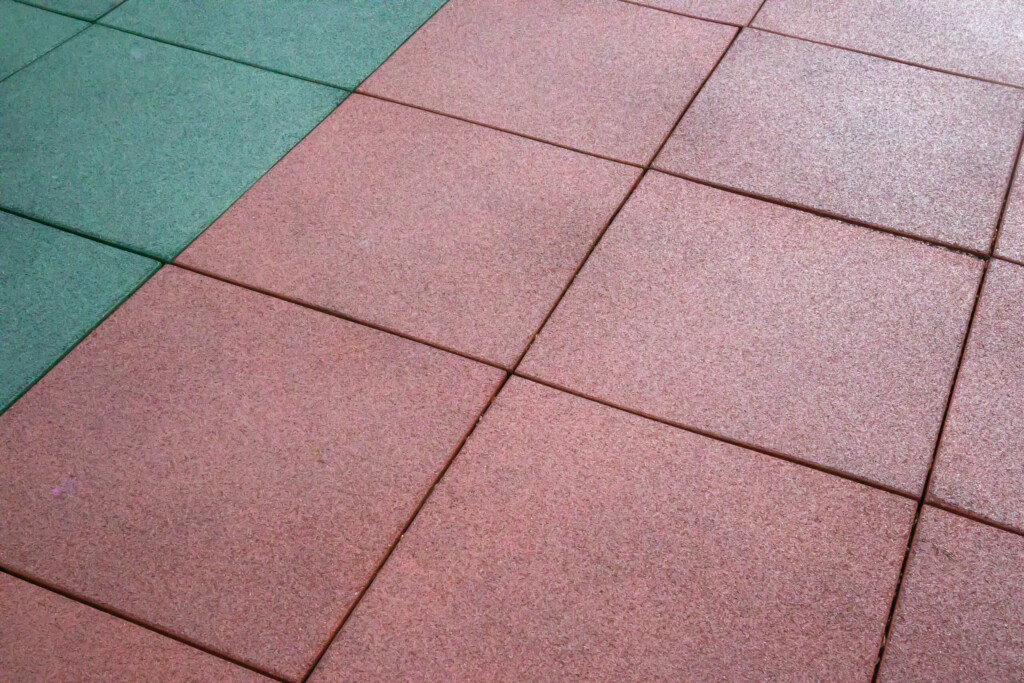
Health and safety advocacy isn’t for the faint of heart.
“At the end of the day, it’s very easy to feel unseen in it. Sometimes it just brings you so much headache and heartache. But, in the end, this bill made it worth it,” says Melissa McNally. She’s a physical education teacher in Washington Township, the Washington Township Education Association’s elementary vice-president and a member of the union’s health and safety committee.
She’s describing the years-long fight behind the new law banning new mercury-laced synthetic polyurethane (“rubber”) flooring in schools, day cares and recreational centers. Senate bill 1370 took effect in September. It’s a major step forward, but it doesn’t meet all of McNally’s goals.
“The work is not 100% done,” McNally adds. “I still think there’s a little more that needs to be nailed down, around timelines and mandatory removal.”
Mercury in gym flooring is a serious hazard
The hazard comes from phenyl mercuric acetate (PMA), a catalyst in poured rubberized polyurethane flooring, first on the market in the 1960s. Mercury vapor does immediate and long-term harm, especially to developing children, a fetus and the immune-compromised. The flooring, and items in contact with it, easily give off odorless toxic mercury vapour indefinitely.
McNally suspects the flooring in the gym where she taught daily since 1999 is behind her rare kidney cancer. She’s careful to say it’s not a certainty. Cancer cells don’t come labeled with a cause, but studies and tests can make the links. However, she mentioned it in her public pleas to the school district and others, while distributing the state’s right-to-know document about phenylmercuric acetate, the substance of concern.
“That single piece of paper was more helpful than any other I had, because it literally said that it was a carcinogen that affected the kidney and the brain. It had everything in there that made my case as to why we can’t risk this and we just need to get rid of it. That fact sheet was gold,” she explained.
McNally wasn’t alone. The New Jersey Work Environment Council (NJWEC), the New Jersey Education Association (NJEA) and Healthy Schools Now have been calling for action about the hazard since 2017.
The state’s current 0.8 μg/m3 (micrograms per cubic meter) threshold for mercury-in-air levels in gyms comes from a 2017 document. That threshold claims to protect children as young as three over the span of eight hours per day for 180 days. However, this limit is 13 times higher than California’s long-established 0.06 μg/m3. There is no national standard.
The state’s 2020 guidance also requires removed materials be treated as hazardous waste, a financial reason for some districts’ reluctance to deal with the floors.
What’s in the new law?
The new law is a big step toward getting rid of rubberized flooring throughout New Jersey schools. It essentially bans new installations in schools, day cares and community centers. To get a construction permit to install, repair, replace or upgrade flooring, districts must provide a manufacturer’s certificate that it is mercury-free; fines for false statements start at $10,000 and go to $25,000 for each offense.
The state health and environmental protection departments must establish and regularly update a publicly available list, naming which flooring needs certification. The law does not require the Department of Education to link to the list, so people unfamiliar with Department of Health’s (DOH) occupational health role, or the law, may not easily find the list.
Removal is the best practice. However, the law allows schools, etc. to keep rubberized flooring if the facility certifies that it has completed an indoor air quality assessment using the DOH’s latest guidance.
Rubberized flooring can also be kept if the facilities demonstrate that they have made remediations (e.g., ventilation) to keep levels at or below the threshold, verified by periodic re-testing. If the mercury levels exceed the threshold, the facility must either lower them or remove and dispose of the flooring within six months.
What can health and safety committees do?
First, ask the district what has been done about rubberized floors in their buildings.
Next, check throughout the school for rubberized flooring; besides gyms, check multipurpose rooms and cafeterias. If it appears the flooring is there, fill out the union report form and request technical help through your local association chapter and UniServ rep.
Other actions you can take include the following:
- Inform members about what’s happening and why. Distribute the WEC/NJEA/HSN fact sheet and survey members for concerns or possible effects
- Use the law and available resources (especially the 2017 guide) to advocate for the following remediations:
- a mercury-in-air threshold of 0.06 μg/m3
- testing by qualified specialists
- assessing concrete floor bases for contamination
- removing flooring followed by clearance tests
- interim measures that limit exposure with a management plan (e.g., close the space, no covering/sealing the floor, cool temperatures, active ventilation with fresh air replacing what is “sucked out”, floor maintenance, record-keeping, assigned responsibilities)
- a link to the public database posted on the district website
Former WEC hygienists who performed many flooring inspections have an additional recommendation: temperature control and monitoring. Mercury levels double for every 9°F temperature increase above 68°F. Keeping mercury levels below the threshold means that temperature monitoring is an essential part of the management plan.
The new law is a major step in regulating synthetic polyurethane flooring, but now the real work—identification, removal and replacement—must begin.
Resources
NJEA Review, Get the word out: Check those gym floors for mercury
NJEA, NJ WEC, HSN, Mercury Hazard in schools from rubber-like polyurethane floors. Health and safety guide!
New Jersey Department of Health, Phenylmercic acetate (Hazardous substance fact sheet)
Habitable’s Informed (the former Healthy Building Network), Flooring product guidance