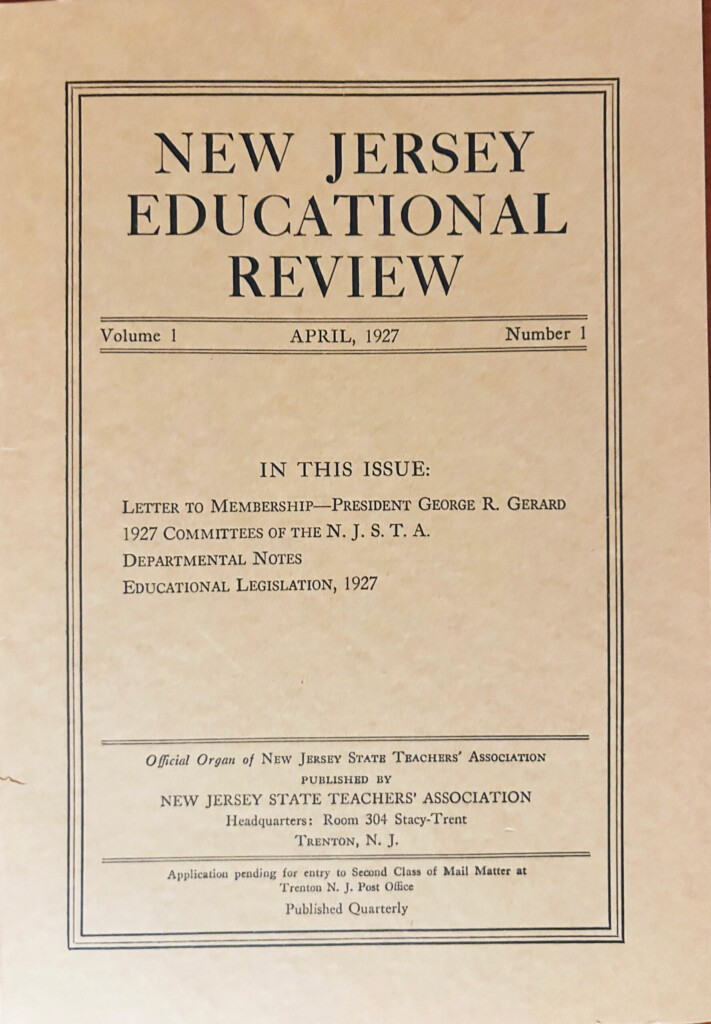
The New Jersey Educational Review proposes at first to give a bird’s-eye view of the association’s past and present and then to keep the membership informed of what is worthwhile educationally in the state and nation with emphasis upon education in New Jersey. The question, ‘What does the association do,’ will be answered as fully as space permits, and it is hoped that individual teachers will feel free to suggest ways and means of broadening the scope of its influence.
“From the Editorial Board,” New Jersey Educational Review, April 1927, Vol. 1, No. 1
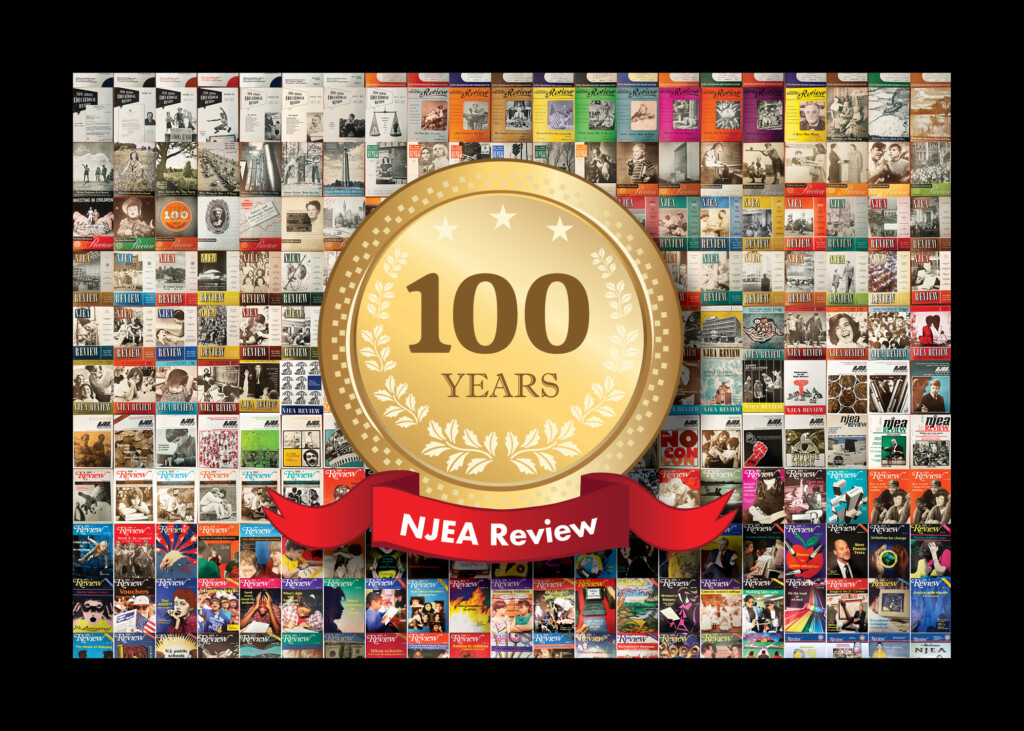
This is the 100th year that what is now known as the NJEA Review has been in production, and this edition is Volume 100, Number 1. Both the association and its official publication went by different names when the Review was launched in the 1926-27 school year. Volume 1, Number 1 of the New Jersey Educational Review was published by the New Jersey State Teachers’ Association (NJSTA).
The need for a statewide education journal
NJSTA was officially founded at its first statewide convention of educators on Dec. 28, 1853. Its creation flowed from the growing number of counties and local associations formed to promote public school education.
Even prior to NJSTA’s founding, there was already interest in a statewide education journal. A previous convention had been called by State Superintendent John H. Phillips in October 1853. It was held in Trenton for the “promotion of the cause of common school education.”
The NJSTA was “clearly an outgrowth of this meeting and its second resolution,” according to the NJEA: The Story of an Organization, prepared by Laurence P. Johnson, for the 100th anniversary of NJEA in 1953. Johnson was the first full-time editor of the Review, serving in that role from 1934 to 1954.
That October 1853 meeting adopted six resolutions. The second, to create an “organization of associations of teachers and friends of education in every county and every town,” led to the founding of NJSTA three months later. The sixth resolution was to adopt a state education journal.
At that time, the convention envisioned the already existing journal, New Jersey Life-Boat and Literary Standard, as the official journal of the soon-to-be created organization. Its editors, conveniently enough, were two Newark teachers and administrators, Isaiah Peckham and William R. Howell. Peckham went on to become NJSTA president in 1858.
NJSTA, once founded, opted instead to name the New York Teacher as its voice. Peckham was its New Jersey editor.
While early documents and editions of the New Jersey Educational Review consistently refer to “teachers,” it appears that this was understood to encompass school administrators. Until 1973, most school administrators were typically members of NEA and NJSTA/NJEA.
Educational support professionals (ESPs) were not typically members of NJSTA, but there were members known as teacher-clerks. These were individuals who handled tasks that professional school secretaries and administrative assistants would handle today, but they also assisted in classroom instruction.
A series of official publications
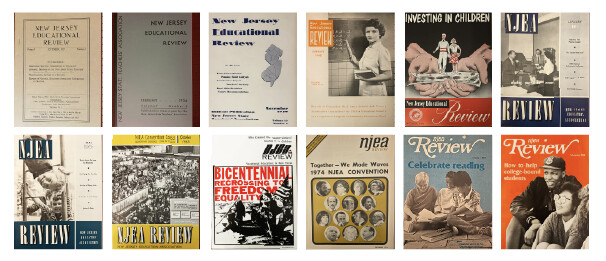
It appears neither the association nor the state had education journals of their own, despite several efforts.
In 1864, a report proposing a state education journal was delivered by a member identified as Mr. E. C. Chapman. According to Johnson’s NJEA: The Story of an Organization, “He spoke on the desirableness and necessity of such a journal as a medium of communication between teachers and for general diffusion of educational intelligence.” A committee was formed to canvass for subscribers.
In 1867, State Superintendent Ellis A. Apgar recommended the creation of a state education journal, resulting a decade later in the New Jersey Public School Journal. It was made the official publication of NJSTA but “seemed to disappear promptly,” according to Johnson.
In 1921, NJSTA named the School News of New Jersey as its official publication, later known as the New Jersey Journal of Education. Samuel Howe, a teacher at South Side High School in Newark was its editor. Apart from its June issue, which was a special association edition, most editions contained one page for association news that was edited by three NJSTA members.
A publication of our own
In early 1926, a Special Committee on a Periodical for the New Jersey State Teachers’ Association was appointed by the NJSTA Executive Committee, chaired by member Hubert R. Cornish, principal of Paterson Public School 4. Cornish presented his committee’s report to the June 19, 1926, meeting of the Executive Committee. The committee unanimously passed a recommendation to “issue annually four or more bulletins, containing matters of importance to the New Jersey State Teachers’ Association” and that it would be the official publication of the organization.
The NJSTA Convention ratified the recommendation at its meeting in the Atlantic City High School Auditorium on Nov. 13, 1926. The Editorial Committee brought out the first issue of the New Jersey Educational Review in April 1927 with an introductory column from the Editorial Committee and another from NJSTA President George R. Gerard of Belleville.
In addition to Cornish, Paul H. Axtell, the supervising principal of Flemington High School, and Catharine M. Zisgen, a music teacher in Trenton, were the Editorial Committee’s other two members.
The content in New Jersey Educational Review was either written or gathered and edited entirely by members. NJSTA Executive Clerk Stella Applegate, the association’s only full-time employee, managed the production.
Everything old is new again
Get a room in A.C.!
What’s most striking about the first edition of the Review is that much of its content would be familiar to today’s members. The very first thing your eyes land upon when you open the cover is an ad promoting hotel lodgings for the 1927 NJSTA Convention—held then, as now, in November in Atlantic City. Members staying at the Ambassador, the convention headquarters, got a special deal.
“The Ambassador has reduced its rates, as a special compliment to association members and their friends,” the ad reads. “$4 per person per day for double rooms with twin beds and a private bath.”
Value for your dues
Then, as now, members wanted to know how their investment in dues benefited them. An article in that first edition titled “What your dollar does,” did just that. At the time, dues were one dollar. Today, you can find “What do I get for my dues?” at njea.org.
Civics education
Many of the early articles were submitted by various NJSTA committees. The Legislative Committee listed bills of interest to teachers that had recently passed, including one on civics education: “S-69 (Wolber) Directs Commissioner of Education to prescribe a course of study in Community Civics in intermediate or elementary school grades and study in Problems in American Democracy in Senior High School Grades approved by him.”
Civics remains top of mind today. The March 2022 edition of the NJEA Review includes the feature “Civics education is back!” which summarized a civics education mandate passed by the state Legislature and signed into law in 2021.
Funding the pension system
Articles discussing the need to ensure that the state made its full contribution to the pension fund—something that seems to show up in nearly every other edition of the current Review—can be found in Vol. 1, No. 1.
“We cannot see how the Legislature can do otherwise than make the appropriation certified by Mr. Buck [George B. Buck, consulting actuary for the pension] without virtually nullifying the provisions of the current law.”
Just this past June, NJEA’s current officers wrote, “We also applaud the continuation of full pension funding. That sustained commitment is restoring stability to a system that was underfunded for decades and is essential to keeping the promise made to hundreds of thousands of public employees.”
Advocacy
NJSTA not only promoted public education for students, it advocated for its members. The Report of the Committee on Grievances and Redress, as printed in the Vol. 1, No. 4 notes the positive outcome of one of its several grievances: “Legal decision has been given that marriage is not a reason for a woman teacher to lose her tenure. A man who marries while in the school system does not lose his tenure; therefore a woman does not.”
The true purpose of education
Criticism of public schools is nothing new. Debates about what our schools should teach were reflected in Vol. 1, No. 1. A reprint titled “What is Education?” from the Paterson Press-Guardian appears in that first issue.
“A certain national magazine the other day complained that our universities and colleges must be falling down on the job, since they teach students so many things that will not help them make a living after they graduate,” the article notes.
After describing that such vocational, business and professional curricula are indeed found in the schools, the article goes on to counter the overarching argument.
“Should we make this kind of training the most important in education?” the article asks. “Is it that we, as a nation, can comprehend and appreciate only those things which readily are convertible into dollars and cents?”
Feature stories
As if to bolster the argument that a public school education does increase a graduate’s earning potential in addition to cultivating their intellect, the very first feature in the very first Review, written by Atlantic City Superintendent of Schools Dr. Charles B. Boyer, highlighted the growth of the then recently built Atlantic City Vocational School.
Features in those early editions came from a wide variety of contributors and an equally wide variety of subjects, such as, “The Financial Affairs of a Teacher,” to the “Progress of Schools in Mexico,” to “Visual Aids and How to Handle Them.” Many of these features were transcriptions of speeches delivered at the NJSTA Convention.
How our schools compare nationwide
Hardly an edition of the today’s NJEA Review goes to press without some variation of the phrase, “New Jersey’s best-in-the-nation public schools.” Vol. 1, No. 1, after listing two standards of criteria used to rank New Jersey, reported that our state ranked fifth in the nation in 1920.
Membership
NJEA has long been a national leader in the percentage of educators, or potential members, who choose to join the union. At 23,814, NJSTA had the second highest percentage of members in the nation in 1927 at 98.64% of potential members. We were second only to Utah, which oddly reported that it had enrolled 102.9% of its potential members. Utah, it seems, admitted private school teachers and “laymen” as members, which took their membership above the total number of actual public school educators in that state. “If these were excluded,” the magazine notes, “in all probability New Jersey would stand first.”
Advertising
From its very first edition, advertising was a feature of the Review. Textbook publishers, study aids and professional development ads filled the final 11 pages of the 34-page edition. For members traveling to the NEA Convention that summer in Seattle, railway companies and travel agencies offered exciting cross-country rail adventures, one of which included a return trip through the Panama Canal.
The president of the association in the 1927-28 school year, Henry P. Miller of Atlantic City, lauded Executive Clerk Applegate for working her connections throughout the state to acquire advertising that supported the Review and the NJSTA Convention program guide.
Different era, same mission
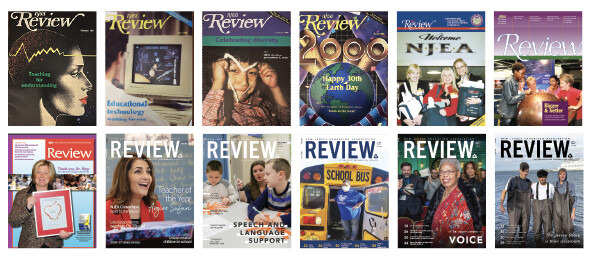
A century later, the magazine now known as the NJEA Review, published by the organization now known as the New Jersey Education Association, continues to serve as the organization’s official publication.
In an age when quality print publications are disappearing, the NJEA Review serves in 2026-27 as a tangible, monthly reminder to members that they are part of something larger than themselves. A union that is dedicated to advocating for and protecting the rights, benefits and interests of its members, while promoting a high-quality, equitable system of public education for all students—just as the New Jersey Educational Review set out to do in in the 1926-27 school year.