In the heart of my “Triumphant Third Grade” classroom, a transformation occurred over ten days that redefined what English Language Arts (ELA) and Social Studies look like for eight-year-olds. We didn’t just read about history; we stepped into the shoes of the 1913 Paterson Silk Strike workers to understand the true power of solidarity.
This journey was made possible by the American Labor Museum and the NJ Historical Commission. Their incredible initiative to publish 30,000 children’s books on the 1913 Paterson Silk Strike meant that every student in my class had their own copy to hold, annotate and cherish. History was no longer a distant concept, but a tangible story they held in their hands.
The reality of “Silk City”
We began our unit by looking at historical photographs of child workers—boys and girls with soot-stained faces who were no older than my own students. Triumphant Third was stunned to learn that children were once the backbone of the factories in Paterson, NJ, famously known as “Silk City.”
We analyzed the grueling reality of a 10-hour workday. We mapped out the exhaustion: rising in the dark, the long walk to the mill, standing for ten hours near loud, dangerous machinery with no lunch break and returning home only to begin hours of housework. When the students finally understood the math of the workers’ slogan—”8 hours for work, 8 hours for rest, 8 hours for what we will”—it clicked. They realized that “what we will” meant time for joy, family and the education they were currently receiving. Inspired, my students marched around the classroom, chanting the slogan and feeling the rhythm of a peaceful protest. They weren’t just “playing” strike; they were connecting to the feeling of standing up for what is right.
From tragedy to transformation
To understand the courage of the 1913 strike, we had to look back at the 1911 Triangle Shirtwaist Factory fire. My students realized that the safety rules that we take for granted today—fire drills, sprinklers and unlocked exits—were hard-won protections. This historical background provided the “criticality” needed for our ELA work. Focusing on state learning standard L.3.4, we decoded complex terms like solidarity and union, moving beyond dictionary definitions to understanding them as life-saving concepts.
The NJEA Review: A bridge to the present
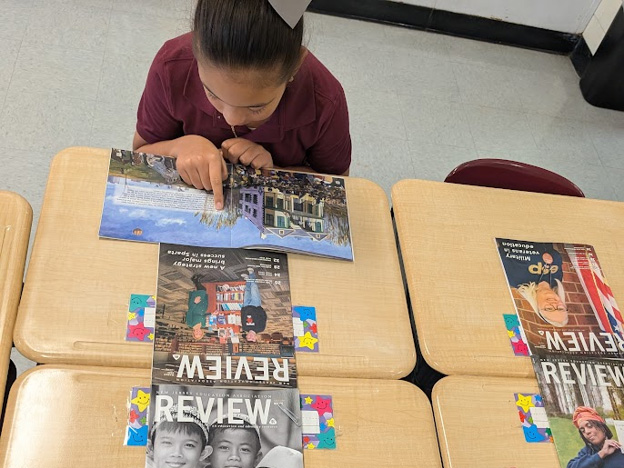
The most empowering moment for me was bridging this history with the present using the NJEA Review. I distributed various editions of the magazine, and the room erupted into a symphony of collaborative learning. Students were pointing to pictures, leaning over desks, and holding up articles to show their teams how NJEA continues to fight for students today. This targeted literacy task (NJSLS RI.3.2) helped them determine main ideas and see the continuity of the union’s impact. They saw that the struggle for fairness didn’t end in 1913; it lives on through the educators who support them every day.
Our union wish
Our final activity, “Solidarity Forever: My Union Wish,” translated history into modern action (NJSLS W.3.1). After defining solidarity as “sticking together to make things better,” students wrote opinion pieces on school improvements. They advocated for more art time or longer recess, proving they understood that collective voices are louder than one. One student wrote the following: “If my whole class acted with solidarity and asked for this, I think it would happen because we are stronger together.”
By the end of these ten days, my students discovered they are part of a legacy of justice. They are the Triumphant Third and they now know that when we stand in solidarity, we have the power to change our world.